
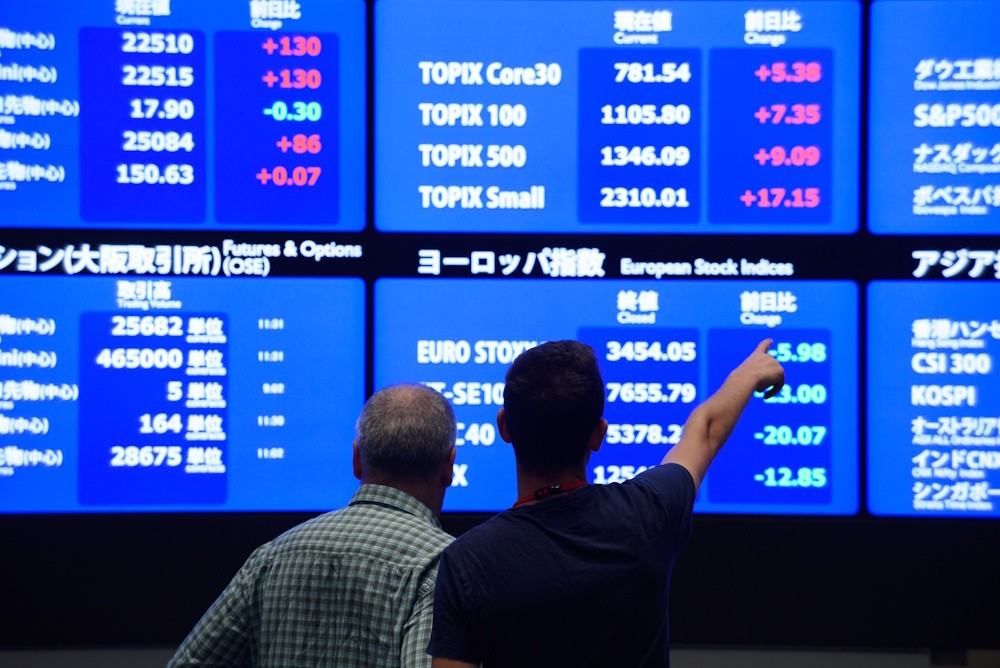
On Monday, the majority of Asia-Pacific markets experienced a decline, as investors evaluated the implications of the Trump administration’s recent threats regarding Greenland, alongside the release of significant economic data from China. During the weekend, U.S. President Donald Trump engaged in a heated exchange with European leaders regarding the Arctic territory, issuing threats of tariffs against eight European nations while asserting a claim over Greenland, which is under Danish sovereignty. European leaders characterized the threats as “completely wrong” and “unacceptable.” In Asia, China disclosed its fourth-quarter GDP figures, accompanied by December statistics for retail sales, urban investment, and industrial output.
The Hong Kong Hang Seng index experienced a decline of 1.07%, while the mainland Chinese CSI 300 saw a slight decrease. Japan’s Nikkei 225 fell by 0.65%, closing at 53,583.57, marking three consecutive sessions of losses, while the Topix also edged lower to finish at 3,656.4. Yields on long-term Japanese Government Bonds climbed to new highs, with the benchmark 10-year JGB yield peaking at 2.279%, its highest level since 1999, while yields on 20- and 30-year JGBs reached unprecedented levels.
South Korea’s markets displayed resilience amid the broader regional weakness, as the Kospi rose by 1.32% to close at 4,904.66, and the small-cap Kosdaq gained 1.44% to finish at 968.36. Automaker Hyundai reached a record high, with its shares surging by as much as 17.92% on Monday. Australia’s S&P/ASX 200 declined by 0.33% to settle at 8,874.5, weighed down primarily by technology stocks. In commodities, spot silver and gold prices climbed to record highs, with silver jumping over 3.88% to $93.38 per ounce and gold rising 1.72% to $4,673.96 per ounce.
In the United States on Friday, the S&P 500 closed slightly below flat, marking a week of losses, while the Nasdaq Composite slipped 0.06% and the Dow Jones Industrial Average fell 0.17%. The three major indexes hit session lows following Trump’s remarks at the White House, where he expressed a preference for National Economic Council Director Kevin Hassett to remain in his current role, suggesting that Hassett may not be chosen as the next U.S. Fed chair. Hassett is viewed as a more market-friendly candidate compared to former Fed Governor Kevin Warsh, who is emerging as a frontrunner, and is expected to be more inclined toward maintaining lower interest rates.