
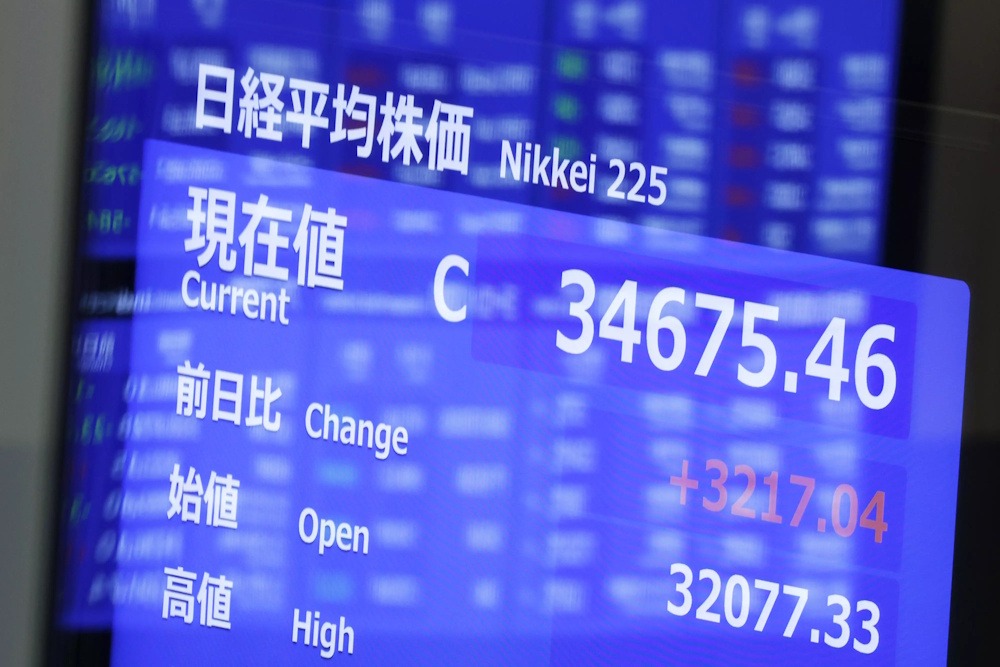
Japanese stocks have reached unprecedented levels, fueled by a resurgence of confidence in domestic political dynamics and the economic strategies of the ruling administration. However, analysts caution that there exists a disjunction between the stock market performance and underlying economic fundamentals. Japan’s Nikkei 225 has achieved notable milestones in recent days, surpassing 56,000, then 57,000, and approaching 58,000, driven by the phenomenon referred to as the “Takaichi trade,” in the wake of Prime Minister Sanae Takaichi’s decisive victory in the Lower House. Japan’s stock market, which is closed on Wednesday for a holiday, experienced the Nikkei reaching a peak of 57,960 on Tuesday. The index has experienced an increase of approximately 15% year-to-date. Market observers note that political optimism has emerged as a fundamental support for the rally, driven by Takaichi’s robust electoral mandate. Equity investors have responded positively to the potential for increased expenditure, tax reductions, and a more proactive economic strategy. However, analysts caution that enthusiasm may be running ahead of clarity on how those policies will be funded, and that Japan’s current equity market foundations appear increasingly fragile: susceptible to currency fluctuations, global shocks, and an expanding disparity between prices and fundamentals.
Richard Harris remarked that the current market gains are challenging to substantiate solely based on economic strength: “It’s not really driven by fundamentals.” “If one examines the currency’s fluctuations and the overall economic performance, there is a lack of compelling evidence to substantiate the market’s movements.” In the three months leading up to September, Japan’s economy experienced a contraction of 0.4% on a quarter-on-quarter basis, marking the first decline in six quarters, according to government data released in November. The economy contracted at an annualized rate of 1.8%. The nation holds the title of the most indebted globally, exhibiting a debt-to-GDP ratio nearing 230% by 2025, according to data from the International Monetary Fund, while heightened fiscal expenditure poses the risk of exacerbating the debt burden. In November, the government sanctioned a fiscal stimulus package exceeding $135 billion, necessitating heightened borrowing. Harris indicated that sentiment, liquidity, and narrative were the primary factors influencing the market. “We’ve observed similar trends in other markets,” he noted, emphasizing that Japan was not an outlier in achieving record highs in the context of global enthusiasm for equities and AI-related investments.
Stefan Angrick noted that the AI boom has elevated stocks on a global scale, a trend that is also evident in Japanese equities. “The current situation appears somewhat precarious, as valuations are influenced by the surge in global equities,” Angrick stated. Japan’s significant involvement in global manufacturing and capital goods positions it as a key beneficiary of the AI expansion. However, this connection renders the market vulnerable to any decline in global technology enthusiasm or to fluctuations in its currency, which has subtly undertaken much of the substantial work, he noted. The sensitivity has become increasingly evident in recent months, as concerns regarding an AI bubble have contributed to market volatility, particularly affecting Japanese stocks. Last week, the software sector experienced a sell-off following the release of new AI tools by artificial intelligence company Anthropic, aimed at managing complex professional workflows that numerous software firms provide as essential services. Angrick noted that the current level of valuation is rendered somewhat fragile by the yen. The yen has depreciated significantly over the past year, a development that typically benefits equities in Japan, considering that a substantial portion of the market consists of manufacturers reliant on exports. A depreciating yen enhances corporate profits and elevates stock valuations, although this effect may diminish in the long run. “The yen is trading significantly detached from its underlying fundamentals. Essentially, it lacks sufficient strength. “It’s unreasonably weak,” he stated.
The Japanese yen has depreciated approximately 3.67% relative to the dollar over the past six months, according to data. Japan has indicated the possibility of intervention should the yen’s decline persist, with Finance Minister Satsuki Katayama expressing apprehensions to U.S. Treasury Secretary Scott Bessent regarding the yen’s “one-sided depreciation.” Aberdeen Investments anticipates that the yen will strengthen due to a gradual rise in real interest rates, as inflation is projected to decelerate more than is presently acknowledged. Angrick also anticipates a strengthening of the currency. “The expectation is that over the medium term, the yen should appreciate, and that we’ll see equity valuations come down a little bit,” adding that currency normalization could “take quite a big chunk out of where equities are right now.” However, that is not to suggest that Japan’s stock market boom lacks sustainability. Experts noted that structural reforms implemented in recent years, especially those concerning corporate governance, capital efficiency, and shareholder returns, have fostered sustainable growth. Firms have increased their share repurchase activities, dismantled cross-shareholdings, and intensified their focus on return on equity, a transformation prompted by the Tokyo Stock Exchange.
Certain asset managers contend that Japan’s corporate fundamentals continue to be generally favorable, contingent upon the fulfillment of expectations. Zuhair Khan remarked that the rally is “genuine” insofar as a robust and stable government instills confidence in the market; however, he cautioned that current prices already reflect anticipated progress that has not yet been realized. “The market is already pricing in some improvements that have not yet happened,” he stated, referencing expectations for asset sales, buybacks, and margin enhancement. That allows for minimal scope for disappointment. “If the pace of improvement slows down, then there is downside risk,” Khan stated.