
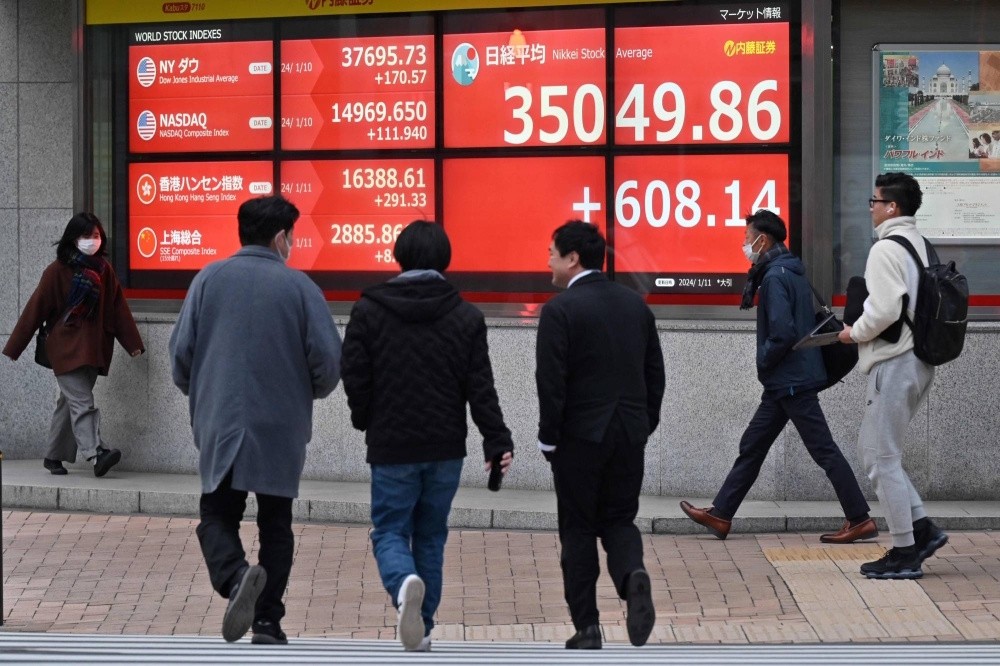
Asia-Pacific markets exhibited a mixed performance on Monday as investors evaluated the implications of elevated oil prices alongside the latest developments in the intensifying U.S.-Iran conflict. U.S. crude prices have surpassed $100 per barrel as the Trump administration considers military action against Tehran’s Kharg Island, a strategically important location frequently described as Iran’s “oil lifeline.” U.S. crude oil exhibited stability, maintaining a price of $98.7 per barrel as of 8:10 pm. Brent prices, the international benchmark, increased by 0.48% to $103.7 per barrel. President Donald Trump on Friday authorized military strikes targeting Iranian assets on Kharg Island and issued a warning regarding potential additional attacks on the crude facilities situated in that region. Mike Waltz, the U.S. ambassador to the United Nations, reiterated the caution on Sunday. Goldman Sachs estimates that the surge in energy prices stemming from the war in Iran could reduce global GDP by approximately 0.3% over the next year, while elevating headline inflation by around 0.5% to 0.6%.
Anticipated increases in natural gas prices are likely to contribute to additional inflationary pressures and pose challenges to growth, especially in Europe and Asia. The risks appear to be weighted toward more significant effects should the Strait of Hormuz remain closed, as noted by the bank in its recent communication. Hong Kong’s Hang Seng index increased by 1.45%, closing at 25,834.02, whereas the CSI 300 remained unchanged at 4,671.56, reflecting better-than-expected performance in China’s consumption and production, driven by holiday spending and robust foreign demand. Retail sales for the first two months of the year increased by 2.8% compared to the same period last year, surpassing the anticipated growth of 2.5%. However, this marks a significant deceleration from the 4% growth observed in the January-February period of 2025. Industrial output increased by 6.3%, surpassing the anticipated 5% rise indicated in a poll.
Industrial production has emerged as a notable strength within the world’s second-largest economy, driven by robust external demand, especially from European and Southeast Asian countries. Japan’s Nikkei 225 experienced a decline of 0.13%, settling at 53,751.15, whereas South Korea’s Kospi saw an increase of 1.14%, reaching 5,549.85. Australia’s S&P/ASX 200 experienced a decline of 0.39%, settling at 8,583.40. Bitcoin experienced an increase of more than 3%, reaching $73,844.20, whereas ether surged by 6%, attaining a value of $2,263.93. Bitcoin experienced a 5% increase last week and has risen approximately 10% since the onset of the Iran war on February 28. Stock futures experienced a modest increase as US Market endeavored to rebound from yet another week of losses.
Futures for the Dow Jones Industrial Average increased by 153 points, reflecting a rise of 0.3%. S&P 500 futures increased by 0.3%, while Nasdaq-100 futures also saw a rise of 0.3%. On the previous Friday, the three principal U.S. averages experienced a decline. The S&P 500 experienced a decline of 0.61%, positioning it 5% beneath its recent peak, with a closing value of 6,632.19. The Nasdaq Composite experienced a decline of 0.93%, concluding the session at 22,105.36. The Dow Jones Industrial Average experienced a decline of 119.38 points, representing a decrease of 0.26%, ultimately closing at 46,558.47.