
Asian equities exhibited a mixed performance on Monday, as several major markets remained closed for holidays, while investors kept a close watch on the evolving situation in the Middle East conflict. On Sunday, President Donald Trump reiterated his threats to target Iran’s power plants and civilian infrastructure, with actions set to commence on Tuesday should Tehran not fully reopen the Strait of Hormuz. This strategic waterway is critical, as it facilitates the passage of approximately one-fifth of the global oil supply, prior to the onset of regional conflict on February 28. In a fervent social media statement, Trump pledged to bring “Hell” to Iran following the rescue of an American airman by U.S. forces last week. He subsequently communicated a deadline of “Tuesday 8 P.M. Eastern Time” without providing further details. The White House on Sunday informed MS NOW that the date has been established as the new deadline for Iran to negotiate a deal with the U.S. stated he will conduct a press conference “with the Military” at the Oval Office at 1 p.m. on Monday.
Iran has, however, dismissed Trump’s ultimatum to reopen the Strait of Hormuz, asserting that the vital waterway will only be fully reopened once compensation for the war damage is addressed. Tehran has persisted in its strikes on economic and infrastructure targets within the adjacent Gulf region, notably including Kuwait’s oil headquarters. In a development indicative of advancements in the peace negotiations, Axios has indicated that Washington and Tehran are involved in discussions facilitated by certain Gulf states regarding a prospective 45-day ceasefire that may bring an end to the conflict. However, the likelihood of achieving a partial agreement prior to the Tuesday deadline appears to be minimal. “The question is whether or not a more favourable outcome can be reached without another round of exchanges that can potentially narrow the path to lower intensity conflict in the medium term,” stated Homin Lin noting that investors will exercise caution in their trading as they respond to headlines.
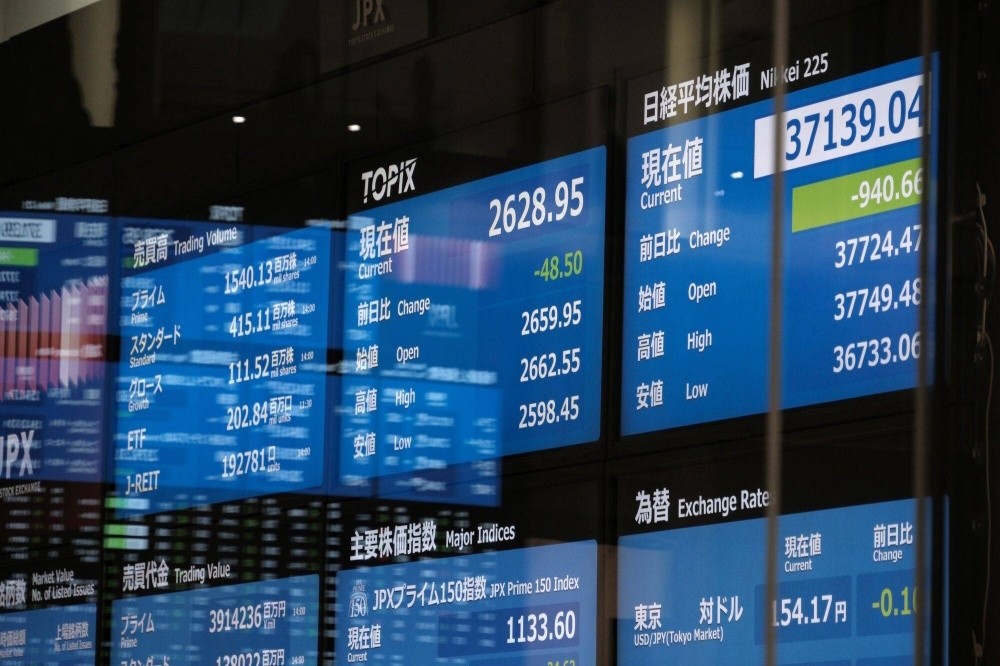
Should Trump proceed with his plans to target Iran’s power grid and civilian infrastructure, risk assets could potentially experience a further decline, Lin noted. “The ongoing uncertainty regarding the resolution of the Iran situation is expected to contribute to continued market volatility.” Japan’s Nikkei 225 increased by 0.55%, concluding the session at 53,413.68, while the broader Topix index remained unchanged at 3,644.8. In South Korea, the blue-chip Kospi experienced an increase of 1.36%, reaching a level of 5,450.33, whereas the small-cap Kosdaq saw a decline of 1.5%, settling at 1,047.37. India’s benchmark Nifty 50 increased by 0.62%, reversing earlier losses in the session, while the BSE Sensex rose by 0.68% as of 1.45 pm. Numerous markets across Asia will remain closed on Monday due to various holidays. Australia, New Zealand, and Hong Kong observe Easter, while mainland China and Taiwan commemorate the Qingming Festival, also known as the tomb-sweeping holiday.
On Sunday, eight members of the Organization of the Petroleum Exporting Countries and their allies increased their production quotas by 206,000 barrels per day for May. However, this adjustment seems primarily symbolic, given that the ongoing conflict has limited shipments from several member countries. The U.S. West Texas Intermediate for May declined approximately 2% to $109.3 per barrel. International benchmark Brent crude prices experienced a decline exceeding 1%, settling at $107.8 per barrel as of 4:15 am. Futures on Wall Street recorded slight increases overnight, with those associated with the S&P 500 and Nasdaq-100 rising by 0.22% and 0.42%, respectively. Futures for the Dow Jones Industrial Average exhibited minimal movement, increasing by 0.04%.