
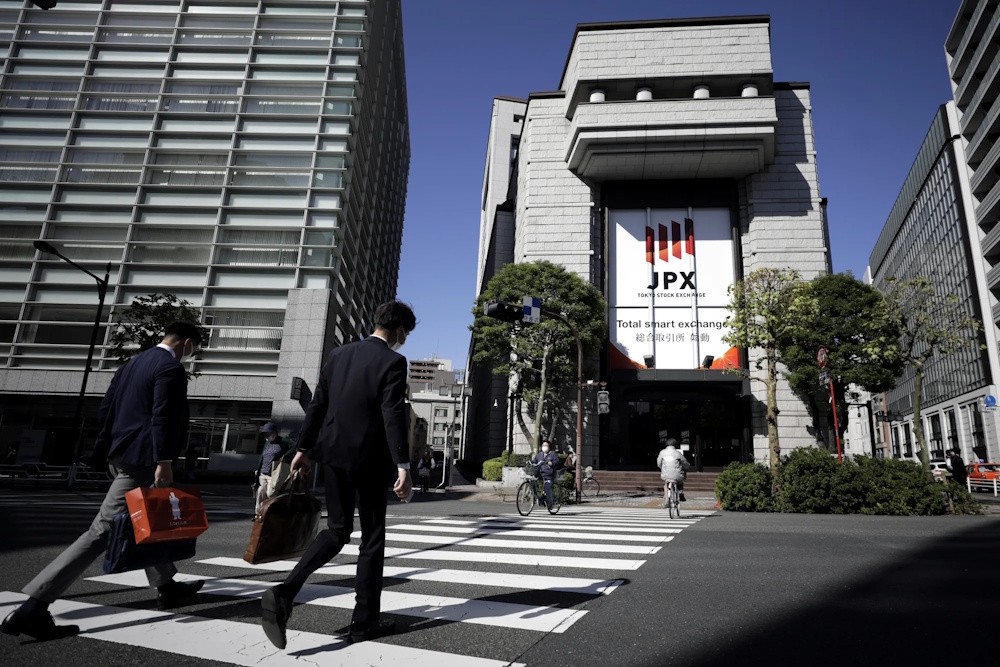
On Monday, Asia-Pacific markets experienced a significant decline, with key indexes in Japan and South Korea dropping by as much as 5%. This downturn reflects a broader trend as investors moved away from risk assets in response to the intensifying conflict in the Middle East, which has now persisted for four weeks. President Donald Trump stated on Saturday that he would “obliterate” Iran’s power plants if Tehran did not fully reopen the Strait of Hormuz — a crucial conduit for global energy flows — within 48 hours. Iran has responded assertively, indicating a willingness to strike energy infrastructure and desalination facilities in the Gulf should the U.S. proceed with its ultimatum. Iran’s Parliament speaker Mohammad Bagher Ghalibaf stated on Saturday that assaults on the nation’s power facilities would be met with prompt retaliatory actions targeting energy and oil infrastructure throughout the region. “Critical infrastructure and energy and oil infrastructure throughout the region will be considered legitimate targets and irreversibly destroyed, and oil prices will rise for a long time,” Ghalibaf stated on X.
Japan’s Nikkei 225 experienced a decline of 3.5%, closing the session at 51,515.49, which reflects a reduction in losses compared to the previous session. Meanwhile, the broader Topix index fell by 3.4%, ending at 3,486.44. South Korea’s blue-chip index experienced a significant decline of 6.5%, closing at 5,405.75, while the small-cap index saw a drop of 5.6%, finishing the session at 1,096.89. The abrupt sell-off led to a temporary suspension of trading on the Korean exchange earlier in the day. Australia’s S&P/ASX 200 experienced a decline of 0.74%, closing at 8,365.9. The Hang Seng Index in Hong Kong experienced a decline of 3.5%, settling at 24,382.47, while the mainland CSI 300 fell by 3.3% to 4,418. On Sunday, Ghalibaf escalated the warning to holders of U.S. Treasurys, indicating that financial entities that acquire American government bonds and “finance the U.S. military budget” would be deemed legitimate targets, in addition to military bases. Crude prices experienced significant fluctuations in a volatile trading session on Monday. Brent crude exhibited a reversal of its earlier losses, achieving an increase of 0.65% to reach $112.68 per barrel as of 10:57 pm. The U.S. West Texas Intermediate experienced an increase of 0.8%, reaching a price of $99 per barrel.
Goldman Sachs has significantly increased its projections for oil prices, anticipating that Brent will average $110 during March-April, a rise from the previous estimate of $98, while WTI is expected to average $98 in March and $105 in April. “We now assume that Hormuz flows remain at only 5% of normal levels for a longer 6-week period before a gradual 1-month recovery,” the Wall Street bank stated, indicating that prices are likely to trend higher over that period until investors gain confidence that a prolonged disruption can be ruled out. Gold prices experienced a decline of 6.6%, reaching $4,188.99 per ounce, marking a continuation of the downward trend to a level not seen in nearly four months. Anticipations surrounding war-induced inflation are likely to sustain elevated interest rates, thereby diminishing the allure of the non-yielding metal in comparison to interest-bearing assets.
In a similar vein, silver prices experienced a decline of approximately 8%, settling at $62.39. In the U.S. overnight, stock futures exhibited minimal variation. The Dow Jones Industrial Average exhibited little movement, remaining flat, while the S&P 500 experienced a decline of 0.1%. Meanwhile, the Nasdaq Composite futures saw a retreat of 0.2%. The three major indices concluded the previous week on a downward trajectory, with the S&P 500 experiencing a decline exceeding 1.5% and dipping below its 200-day moving average for the first occasion since May. The Dow experienced its initial four-week losing streak since 2023, while the Nasdaq declined by approximately 2% over the week.