
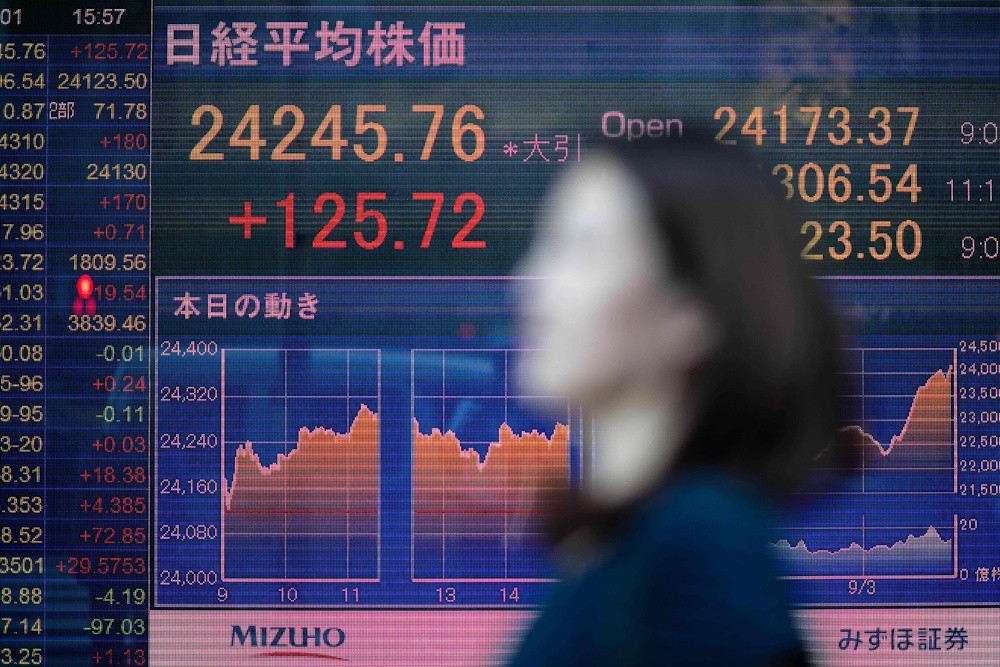
On Monday, Asia-Pacific markets experienced a significant decline as the conflict in the Middle East extended into its fifth week, intensifying despite ongoing diplomatic efforts to reach a resolution. The benchmark Kospi experienced a decline exceeding 5%, ultimately reducing its losses to finish 2.97% lower at 5,277.3, while the small-cap Kosdaq decreased by approximately 3% to 1,107.05. Japan’s Nikkei 225 experienced a decline of 2.79%, closing at 51,885.85, while the Topix recorded a drop of 2.94%, ending at 3,542.34. At their March meeting, Bank of Japan policymakers deliberated on the necessity for additional rate hikes, given that escalating oil prices associated with the Middle East conflict are contributing to inflationary pressures. A member indicated that the pace of tightening might require acceleration, based on a summary of opinions published on Monday.
A policymaker highlighted the risk that the BOJ may inadvertently lag behind the curve, as second-round effects and an increase in underlying inflation driven by external developments are becoming more probable. Australia’s S&P/ASX 200 experienced a decline of 0.65%, concluding the trading session at 8,461. Hong Kong’s Hang Seng index experienced a decline of more than 1%, whereas the CSI 300 decreased by 0.24%, settling at 4,491.95. On Saturday, Yemen’s Houthi movement announced that it had launched missiles at Israel, indicating its inaugural direct engagement in the conflict orchestrated by the U.S. and Israel against Iran. In a recent post on X, Houthi spokesperson Yahya Saree announced that the group had initiated a series of ballistic missile strikes targeting what they characterized as sensitive Israeli military installations, in alignment with Iran and allied Hezbollah forces in Lebanon. The strike indicates a notable intensification in a conflict that originated with U.S. and Israeli airstrikes on Iranian targets on February 28.
Oil prices experienced an uptick during the early trading hours in Asia. West Texas Intermediate crude futures experienced an increase of 2.58%, reaching a price of $102.19 per barrel. Australia will reduce the fuel excise on petrol and diesel by fifty percent for a period of three months to alleviate the increasing costs attributed to the U.S.-Israeli conflict with Iran, as stated by Prime Minister Anthony Albanese during a press conference in Canberra. The anticipated tax reduction is projected to decrease pump prices by 26.3 Australian cents per litre (18 cents), he noted. In the United States, futures associated with the Dow Jones Industrial Average declined by 253 points, representing a decrease of 0.6%. S&P 500 futures and Nasdaq 100 futures experienced a decline of 0.5% each.
Last Friday, the Dow Jones Industrial Average experienced a significant decline, entering correction territory. The 30-stock Dow experienced a decline of 793.47 points, representing a decrease of 1.73%, concluding the session at 45,166.64. The S&P 500 experienced a decline of 1.67%, concluding the session at a seven-month low of 6,368.85. The Nasdaq Composite experienced a decline of 2.15%, concluding the session at 20,948.36. The broad market index recorded its fifth consecutive weekly decline, decreasing by 2.1% during the period. The technology-focused Nasdaq experienced a decline of 3.2% week to date, whereas the blue-chip Dow saw a decrease of 0.9% for the week.