
On Tuesday, the majority of Asia-Pacific markets experienced declines as oil prices exhibited volatility following a report indicating that U.S. President Donald Trump aimed to prevent an extended conflict in the Middle East. It is reported on Monday evening that Trump informed aides of his willingness to conclude U.S. military hostilities against Iran, even in the event that the Strait of Hormuz remained predominantly closed. The West Texas Intermediate futures for May delivery experienced a decline of 0.1%, settling at $102.78 per barrel as of 3:42 am. May futures for Brent crude increased by 0.24% to $113.05 per barrel, following a recovery from earlier declines.
Trump and his aides evaluated that an initiative focused on reopening the essential chokepoint could extend the conflict beyond the initial six-week timeline for the war, according to the reports. “Trump could be compelled to concede in order to manage gas prices and consequently inflation ahead of the midterms,” stated Ben Emons emphasizing that Trump’s “verbal signals” regarding the conclusion of the Iran conflict gained traction following Brent’s approach to the $120 per barrel mark. The conflict has progressively evolved into a “asymmetric” scenario, according to Emons, as the United States appears to be moving towards a conclusion of hostilities, whereas Iran persists in inflicting costs. “This is a moment to consider rotating out of the war portfolio and into a rebound portfolio,” he stated. Trump previously issued a warning regarding the potential escalation of attacks on Iran’s civilian energy infrastructure, which encompasses water desalination facilities, should Tehran not take steps to reopen the Strait of Hormuz.
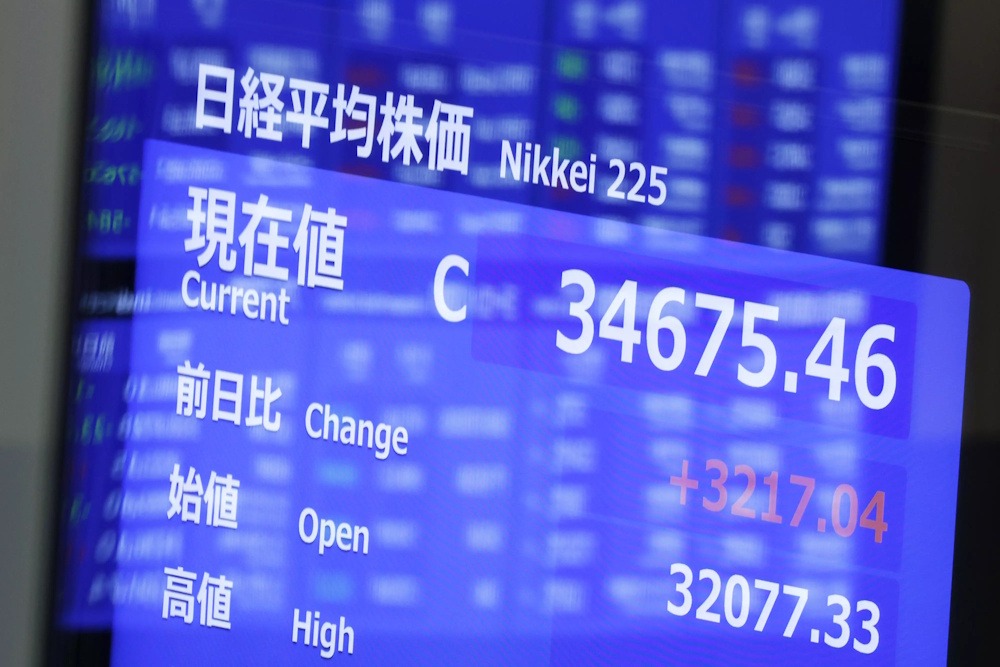
Shipping traffic through the Hormuz waterway, which previously accounted for a fifth of global seaborne oil transit before the onset of conflict, has effectively come to a standstill following the strikes on Iran by the U.S. and Israel on February 28. South Korea’s blue-chip Kospi experienced a decline of approximately 4.26%, closing at 5,052.46, while the small-cap Kosdaq saw a decrease of nearly 5%, finishing at 1,052.39. The Korean won experienced a depreciation of 0.84%, settling at 1,529.9 against the U.S. dollar, and is now positioned close to its lowest level since 2009. Japan’s Nikkei 225 declined by 1.58%, closing at 51,063.72, whereas the broader Topix index recovered from earlier declines to finish 1.26% higher at 2,497.86. Australia’s S&P/ASX 200 experienced an increase of 0.25%, concluding the session at 8,481.8. The Hong Kong Hang Seng index experienced a slight decline during its final trading hour, whereas mainland China’s CSI 300 decreased by 0.93%, concluding at 4,450.05. The markets in India were closed due to a holiday.
Overnight in the U.S., the S&P 500 declined by 0.39%, concluding at 6,343.72, which signifies its third consecutive session of losses, while the Nasdaq Composite decreased by 0.73%, finishing at 20,794.64. The Dow Jones Industrial Average defied the prevailing trend, increasing by 0.11% to reach 45,216. The equities experienced a decline even as Federal Reserve Chair Jerome Powell indicated that the inflation outlook remains stable despite increasing energy prices, asserting that the central bank does not need to react with elevated interest rates. U.S. stock futures exhibited a modest increase, as futures associated with the S&P 500 advanced by 0.3%, while those linked to the Nasdaq 100 experienced a gain of 0.2%. Futures for the Dow Jones Industrial Average increased by 177 points, reflecting a rise of 0.4%.