
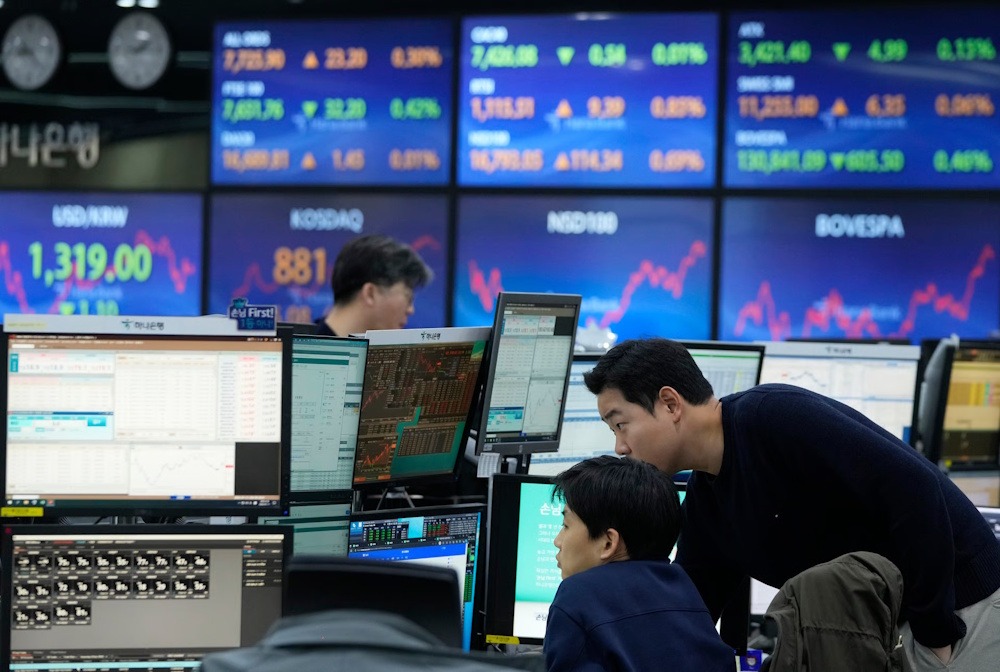
Asia-Pacific markets experienced a rebound on Wednesday following remarks from U.S. President Donald Trump, which heightened optimism regarding a potential resolution to the Iran conflict. On Tuesday, Trump indicated that the U.S. might exit Iran in “two or three weeks,” stating, “We leave because there’s no reason for us to do this.” U.S. West Texas Intermediate crude for May delivery experienced a decline of 3.5%, settling at $97.79 a barrel as of 3 a.m., whereas the Brent contract for June delivery fell by 4.8%, reaching $98.56 a barrel. South Korea’s Kospi experienced a notable increase, rising by 8.44% to close at 5,478.7. The increase represented the Kospi’s most significant rise since March 5, whereas the small-cap Kosdaq experienced a 6.06% ascent, concluding at 1,116.18.
This development followed the release of data indicating that South Korean exports in March surged by 48.3% compared to the previous year, surpassing Reuters poll estimates of 44.9%. Japan’s Nikkei 225 increased by 5.24% to 53,739.68, driven primarily by financial stocks, whereas the broader Topix index gained 4.95%, concluding at 3,670.9. The Bank of Japan’s Tankan survey for the first quarter of 2026, which gauges business sentiment, indicated an increase in optimism among large Japanese manufacturers, rising to 17 from 15. That surpassed the expectations of 16 from economists and attained its highest level since the fourth quarter of 2021. Business sentiment among large non-manufacturers remained at 36, consistent with the prior quarter and surpassing the expectations set by the Reuters poll, which anticipated a figure of 33.
In the final hour of trading, Hong Kong’s Hang Seng index experienced an increase of 1.88%, driven by gains in basic materials stocks. Meanwhile, mainland China’s CSI 300 saw a rise of 1.71%, concluding at 4,526.06. A private survey indicates that China’s manufacturing activity experienced a slowdown in February. The RatingDog PMI registered at 50.8 in February, falling short of the analysts’ expectation of 51.6 and declining from a peak of 52.1 observed in the previous month, which marked a more than five-year high. Australia’s S&P/ASX 200 advanced 2.24% and finished at 8,671.8, propelled by an increase in educational services stocks. India’s Nifty 50 experienced an increase of 2.14%, whereas the Sensex recorded a gain of 2.56% as of 1:30 pm.
U.S. futures exhibited a modest increase, as S&P 500 and Nasdaq-100 futures rose by 0.16% and 0.24%, respectively. Dow futures increased by 44 points, representing a 0.09% rise. Overnight in the U.S., all three major indexes recorded their most significant increase since May, with the Dow Jones Industrial Average rising by 2.49%. The S&P 500 experienced an increase of 2.91%, while the Nasdaq Composite saw a rise of 3.83%. The developments came in the wake of an unverified report indicating that Iranian President Masoud Pezeshkian expressed a willingness to conclude the conflict with certain assurances.