
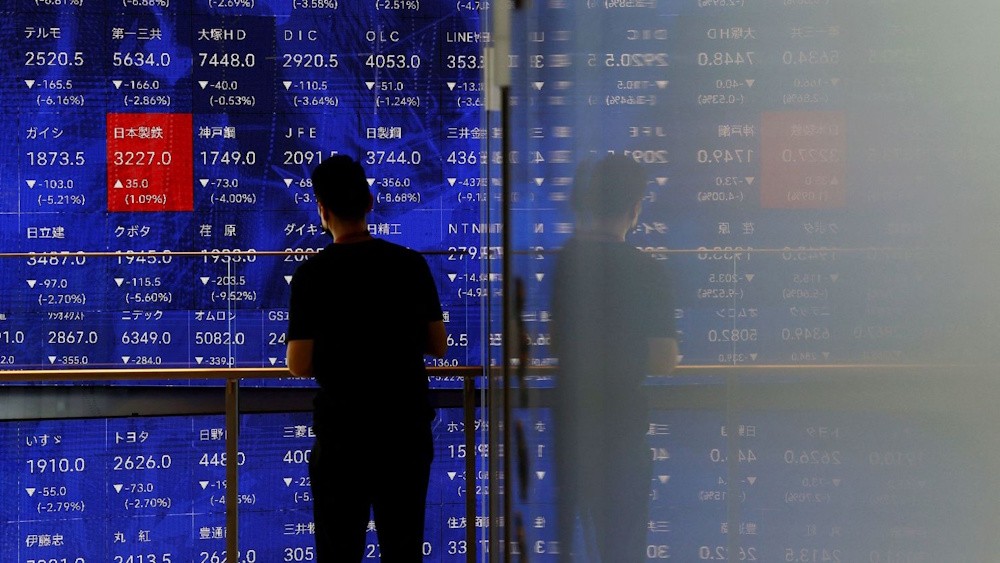
Asian stocks experienced a broad increase on Monday, coinciding with a continued decline in oil prices, fuelled by optimism regarding a potential diplomatic resolution to the U.S.-Iran conflict. Regional volumes were subdued as Japanese markets were closed for a three-day holiday weekend concluding on September 23. The U.S. dollar index remained stable during Asian trading hours, while gold experienced a decline of approximately half a percent, trading at $4,351 per ounce, influenced by anticipations of further rate hikes by the Federal Reserve. Brent crude prices declined by over 2 percent, trading below $102 a barrel, marking a continuation of losses for the fourth consecutive day. This downturn occurs in anticipation of this week’s meeting between U.S. President Donald Trump and leaders from Gulf states, set to take place on the sidelines of the United Nations General Assembly. Ahead of the talks, Trump cautioned Iran that it would encounter economic failure or risk the eradication of its leadership if it did not reach an agreement.
Trump suggested the possibility of a meeting with Iranian President Masoud Pezeshkian in New York, noting that significant developments could occur soon and that he is currently in a “deciding mode” regarding military action, ongoing economic pressure, or a potential agreement. China’s Shanghai Composite index increased by 0.97 percent, reaching 3,949.91, following positive evaluations from U.S. and Chinese officials regarding their discussions. Ahead of the upcoming meeting between Trump and Xi, U.S. Treasury Secretary Scott Bessent emphasised the “very successful” discussions surrounding trade, artificial intelligence, and investment. Earlier today, the People’s Bank of China maintained its benchmark lending rates for the 16th consecutive month, aligning with market expectations. Hong Kong’s Hang Seng index concluded the trading session with a gain of 1.18 percent, reaching 25,042.71, primarily driven by advancements in technology and healthcare sectors.
Shares of Chinese biopharma companies such as Innovent Biologics and Akeso experienced significant increases following reports indicating that the U.S. is developing new regulations for pharmaceutical companies investing in China. Seoul stocks experienced an uptick as investors capitalised on semiconductor shares, reflecting a shift in investor sentiment regarding artificial intelligence. The Kospi index experienced an increase of 1.65 percent, reaching a level of 7,007.72. Market bellwether Samsung Electronics experienced a 5 percent increase, while SK Square, the parent company of chip rival SK Hynix, saw a surge of 4.5 percent, driven by expectations of sustained robust demand. Australian markets rebounded from an initial decline to conclude the session with little change, as investors awaited crucial unemployment figures and the Reserve Bank of Australia’s decision on interest rates. Banks made gains, counterbalancing declines in commodity-related stocks.
Across the Tasman, New Zealand’s benchmark S&P/NZX-50 index experienced a notable increase of 0.60 percent, reaching 13,821.20, thereby offsetting earlier losses observed in the morning. U.S. stocks concluded the trading session on Friday with a mixed performance, influenced by fluctuating oil prices. Additionally, a key indicator of industrial production surprisingly remained unchanged in August, while benchmark Treasury yields surpassed 5 percent, reflecting ongoing uncertainty regarding the Federal Reserve’s monetary policy trajectory. The tech-heavy Nasdaq Composite experienced an increase of 0.4 percent, while the S&P 500 saw a modest rise of 0.2 percent. In contrast, the narrower Dow recorded a decline of 0.2 percent.
