
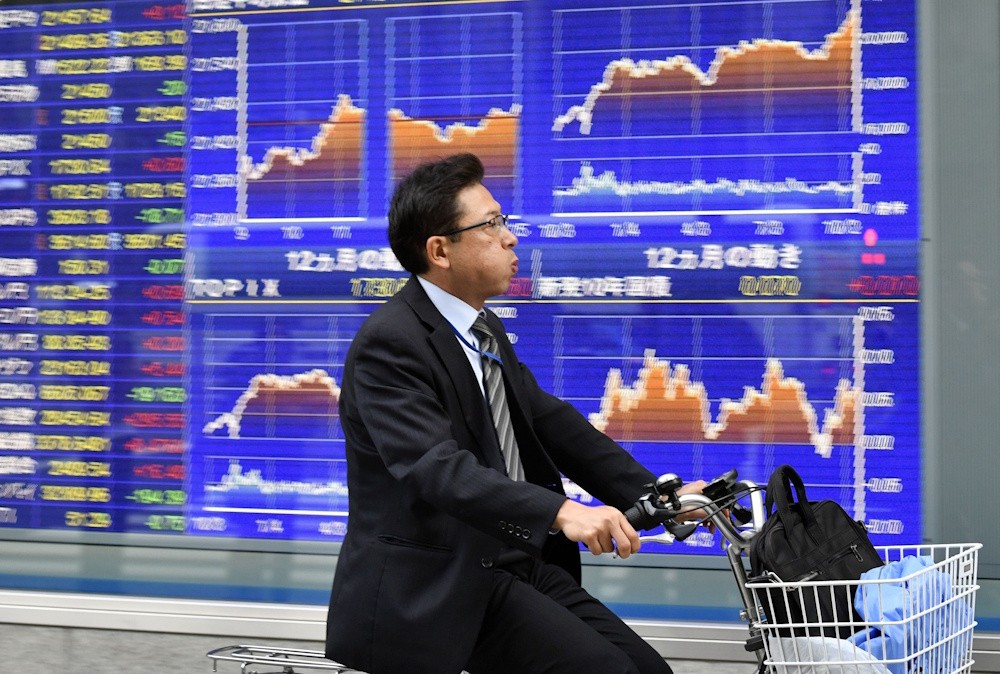
Asia-Pacific markets exhibited a mixed performance on Tuesday as investors considered the renewed tariff threats from U.S. President Donald Trump alongside worries that artificial intelligence might disrupt software companies. On Monday, Trump shared on Truth Social that any nation attempting to “play games” with the Supreme Court decision “will be met with a much higher tariff.” The remarks came in response to a Supreme Court ruling on Friday that invalidated tariffs imposed under the International Emergency Economic Powers Act. In response, Trump stated, “I would impose a 15% global tariff under Section 122 of the 1974 Trade Act.” Lorraine Tan said “We expect limited changes to the agreements already in place and also as we expect President Trump to use these means to improve his bargaining position with those countries where agreements are being negotiated.” Investors in Asia were carefully evaluating China’s decision regarding the loan prime rate. On Tuesday, China’s central bank maintained its benchmark lending rates, with the one-year LPR remaining at 3% and the five-year LPR at 3.5%.
The one-year LPR acts as a standard for new commercial loans, whereas the five-year LPR directs property loans. Markets in mainland China experienced an increase of 1.06% as trading resumed following the Lunar New Year holiday. Hong Kong’s Hang Seng index experienced a decline of 2%, primarily influenced by a downturn in healthcare stocks. Labubu maker Pop Mart experienced the most significant decline on the index, dropping 5%, following the release of a new toy series on Monday. South Korea’s Kospi increased by 2.11%, concluding at 5,969.64. The index achieved a new record high for the third consecutive session, driven by a rally in chip stocks, while the small-cap Kosdaq rose by 1.13% to close at 1,165. The Taiwan Weighted index capitalised on the chip rally, propelling Asian markets forward with a notable increase of 2.75%, reaching a record high of 34,700.82. Chip giant Taiwan Semiconductor Manufacturing Company experienced an increase of over 3.42%.
Japan’s Nikkei 225 rose by 0.87% to reach 57,321.09, while the Topix increased by 0.2%, closing at 3,815.98. Australia’s S&P/ASX 200 relinquished its early gains, declining slightly to 9,022.3. In the U.S. overnight, the Dow Jones Industrial Average fell by 1.66%, and the Nasdaq Composite decreased by 1.13%. The S&P 500 declined by 1.04%. On Monday, cybersecurity stocks experienced a decline for the second consecutive day as investors expressed concerns regarding new artificial intelligence security tools that pose a risk to the established business models within the sector.
On Friday, Anthropic introduced a new security tool for its Claude model, now available in a limited research preview. The AI lab stated that the service has the capability to scan software code for vulnerabilities and propose solutions. Anthropic is set to hold an enterprise briefing featuring new product announcements on Tuesday. Samantha Subin Software stocks, including Microsoft and CrowdStrike, faced renewed pressure as concerns over AI disruption impacted the market. Microsoft experienced a decline of 3%, whereas CrowdStrike saw a significant retreat of nearly 10%.