
South Korea’s benchmark Kospi index recorded its most significant monthly increase, rising nearly 31%, the highest since January 1998, driven by a robust performance in tech stocks that has enabled the market to overlook geopolitical tensions in the Middle East. The index’s substantial increases can be attributed primarily to the prevailing optimism surrounding the artificial intelligence surge, with semiconductor leaders SK Hynix and Samsung Electronics at the forefront, rising 60% and 35%, respectively, over the month. HSBC last week elevated South Korea’s rating to “neutral” from “underweight,” noting that recent foreign outflows have alleviated crowded positioning in the market and diminished downside risks associated with geopolitical volatility.
In addition to the dominant chip manufacturers, HSBC noted that overarching growth trends in sectors like energy storage, shipbuilding, defense, and nuclear power are contributing to the market’s upward momentum. The recent rally marks a significant achievement, occurring amidst a downturn in the broader Asia-Pacific markets, such as the Kospi, which experienced declines on Thursday. This was largely influenced by a surge in oil prices reaching four-year highs, before some recovery, driven by concerns over possible U.S. military intervention in Iran and ongoing uncertainty following the Federal Reserve’s decision to maintain interest rates. The Kospi experienced a decline of 1.38%, settling at 6,598.8, whereas the small-cap Kosdaq decreased by 2.29%, reaching 1,192.35. In Australia, the S&P/ASX 200 experienced a decline of 0.24%, concluding the trading day at 8,665.8.
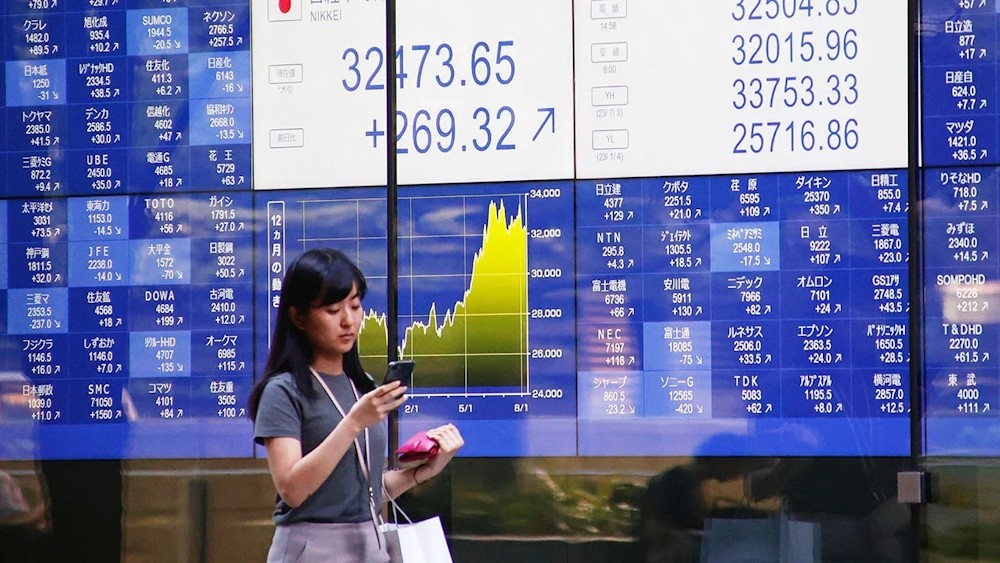
Japanese markets experienced a decline as trading activities resumed following a holiday break. The benchmark Nikkei 225 experienced a decline of 1.06%, closing at 59,284.92, while the Topix saw a decrease of 1.19%, finishing at 3,727.21. Hong Kong’s Hang Seng index experienced a decline of 1.27% during its final trading hour, whereas mainland China’s CSI 300 concluded the session unchanged at 4,807.30. Oil prices increased following a report from Axios, which referenced two sources familiar with the situation, indicating that the U.S. Central Command was preparing to present plans for potential military action against Iran to President Donald Trump. Trump had previously indicated his refusal of Tehran’s proposal to reopen the Strait of Hormuz, suggesting that the naval blockade will persist until a more comprehensive nuclear agreement is established.
June futures for international benchmark Brent crude were last up 3.4% at $121.98 a barrel Thursday, while U.S. West Texas Intermediate added 1.21% to $108.22. Brent crude has reached its peak since mid-2022, according to LSEG data, as the ongoing conflict in the Middle East constrains supply chains. In the U.S., futures linked to the S&P 500 increased by 0.3%, whereas Nasdaq 100 futures rose by 0.5%. Futures for the Dow Jones Industrial Average declined by 128 points, representing a decrease of 0.2%. Overnight in the U.S., the Dow Jones Industrial Average experienced a decline. The 30-stock index declined by 280.12 points, representing a decrease of 0.57%, closing at 48,861.81, marking its fifth consecutive day of losses. The S&P 500 experienced a slight decline of 0.04%, concluding at 7,135.95, whereas the Nasdaq Composite saw a marginal increase of 0.04%, finishing at 24,673.24.
