
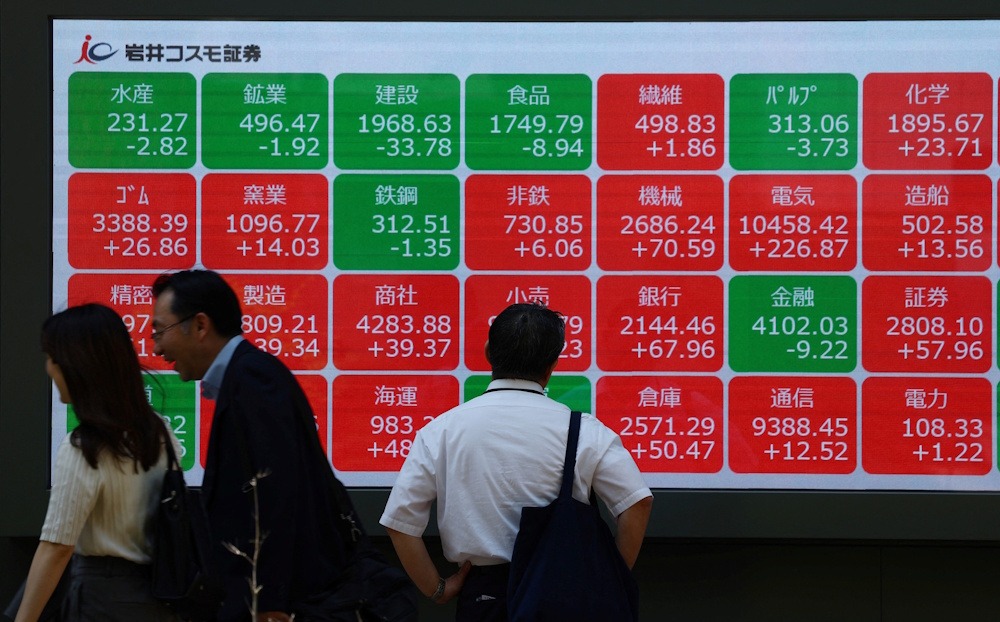
On Thursday, Japan’s Nikkei share average closed nearly 3% lower as chip-related firms sold off and an expanding Middle East war hampered risk appetite. This overshadowed record results and a solid forecast from Taiwan Semiconductor Manufacturing Co. The Nikkei concluded the trading session down 2.8% at 66,835.54, having experienced a decline of as much as 3.3% earlier in the day. Meanwhile, the broader Topix decreased by 1.5%, settling at 4,028.79. Market breadth exhibited a negative trend, as evidenced by 139 decliners on the Nikkei 225 compared to 85 advancers, with one stock remaining unchanged. “There has recently been a noticeable divergence between semiconductor stocks and the broader market, and today is no exception, with high-tech shares undergoing a correction,” said Hiroki Takei.
Taiwan Semiconductor Manufacturing posted a record second-quarter net profit that jumped 77% and exceeded market forecasts, driven by surging global demand for AI processors that significantly boosted earnings. The world’s primary manufacturer of advanced AI chips has also increased its full-year revenue growth forecast in U.S. dollar terms to just above 40%, up from the previous estimate of more than 30%. It was stated that capital expenditure over the next three years would be considerably elevated compared to the preceding three years.
Despite this, investors remained vigilant. Memory chipmaker Kioxia experienced a significant decline, marking the largest loss on the Nikkei with a drop of 15%. SoftBank Group, a technology investment conglomerate, experienced a decline of 6.3%, whereas chip-testing equipment manufacturer Advantest saw a reduction of 5.9%. Takei noted that the recent fluctuations in high-tech shares seem to be influenced more by supply-demand dynamics rather than underlying fundamentals. He highlighted a significant decline in South Korean shares associated with concerns regarding leveraged ETFs and heightened margin buying by individual investors in Japan over the past few weeks.
Broader sentiment faced pressure due to the conflict in the Middle East, following the U.S. executing two waves of attacks on Iran’s coastal defences and missile sites on Wednesday. In retaliation, Iran targeted U.S. military sites in neighbouring countries. Oil prices declined as traders evaluated the potential risks stemming from the renewed clashes. Meanwhile, Nichirei shares surged by as much as 7.7% following the announcement from the frozen-foods and cold-chain logistics firm regarding the resumption of frozen-food shipments and refrigerated warehouse operations that had been suspended due to cyberattacks.
