
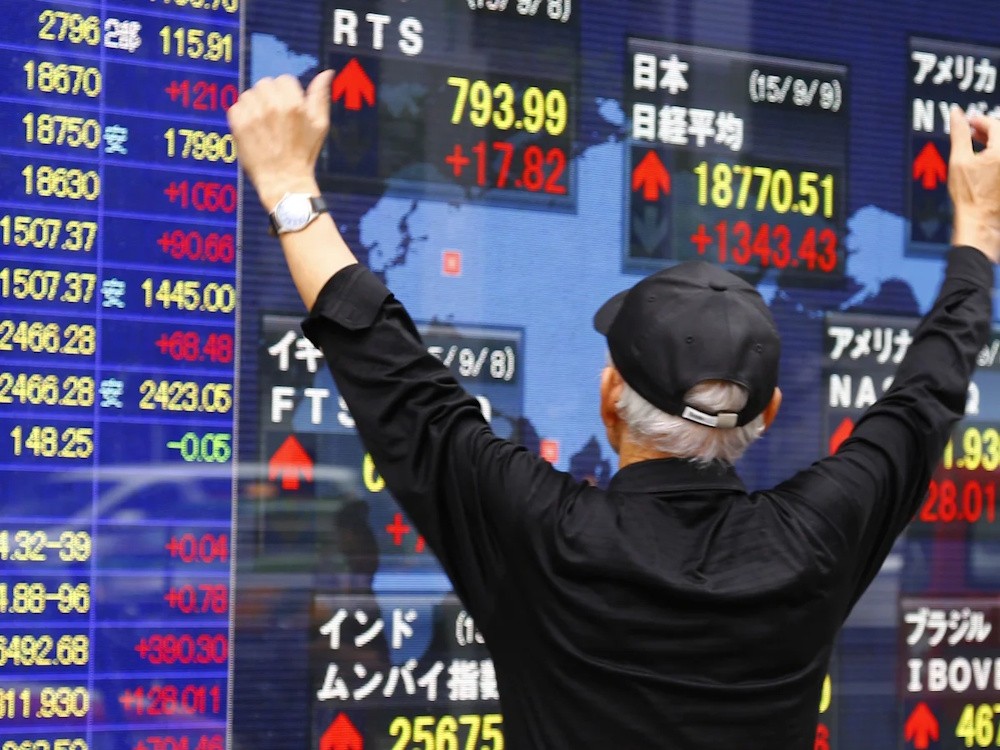
On Tuesday, Japan’s Nikkei share average reached a record high following the Bank of Japan’s anticipated interest rate hike, while indicating no immediate need for additional monetary policy tightening. Japanese government bonds experienced a decline following the decision to increase the key rate by a quarter point to 1%. Meanwhile, the yen remained relatively stable at approximately 160 per dollar, a threshold that traders consider a critical point for potential currency intervention by Japanese authorities. The Nikkei ended the day with a 0.1% gain to close at 69,404.50, although it earlier jumped as much as 1% to reach 70,020.68 for the first time. The broader Topix, however, lost 0.2% on the day to finish at 3,991.14, after initially flipping to gains following the policy announcement, but then retracing that advance.
“Price rises are broadening, and there is a risk that underlying inflation may deviate from our target,” whereas “the risk of a sharp deterioration in the economy has diminished,” BOJ Deputy Governor Shinichi Uchida said at a news conference that began at the same time the stock market closed. He stated that there was no proposal for a half-point rate hike at the meeting. The BOJ’s decision to raise rates for the first time since December occurred during the trading break for stocks and bonds, resulting in minimal immediate impact on the yen. Japan’s currency fluctuated within a limited range, slightly weaker than 160 per dollar, last trading at 160.32. “The BOJ delivered what markets expected,” stated Charu Chanana. “But the reaction shows this was not hawkish enough to force a major yen repricing.” The central bank “is still moving in a very gradual way and continues to say financial conditions will remain accommodative,” she added. This presents a somewhat positive outlook for Japanese equities, as the BOJ is tightening its stance, yet it does so without jeopardising liquidity or earnings. Out of the 225 components of the Nikkei, 78 experienced an increase, while 144 saw a decline, and three remained unchanged.
Several heavily weighted AI stocks significantly influenced the market’s upward movement. Chip-testing machinery manufacturers showed strong performance, with Advantest gaining 3.1%. Similarly, data centre companies also excelled, as Fujikura rose by 9% and Furukawa Electric increased by 4.9%. Benchmark 10-year JGB futures lost 0.49 yen to 127.77 yen as of the end of the regular session. The yield on the 10-year cash bond was 7 basis points higher at 2.655%. Yields increase as bond prices decrease. Moves elsewhere on the curve were more subdued, with the two-year yield increasing by 1 basis point to 1.405% and 30-year yields rising by 3 basis points to 3.775%.
Before Tuesday, yields had been decreasing over the past few weeks from record highs, as inflation concerns eased alongside growing optimism for a near-term resolution to the Iran conflict. In a scenario where inflation accelerates or the yen weakens further, bringing forward the timing of the next rate hike could come into view’, stated Hirofumi Suzuki. Currently though, “the BOJ is likely to continue raising rates at a gradual pace of around once every six months to one year,” he stated.
