
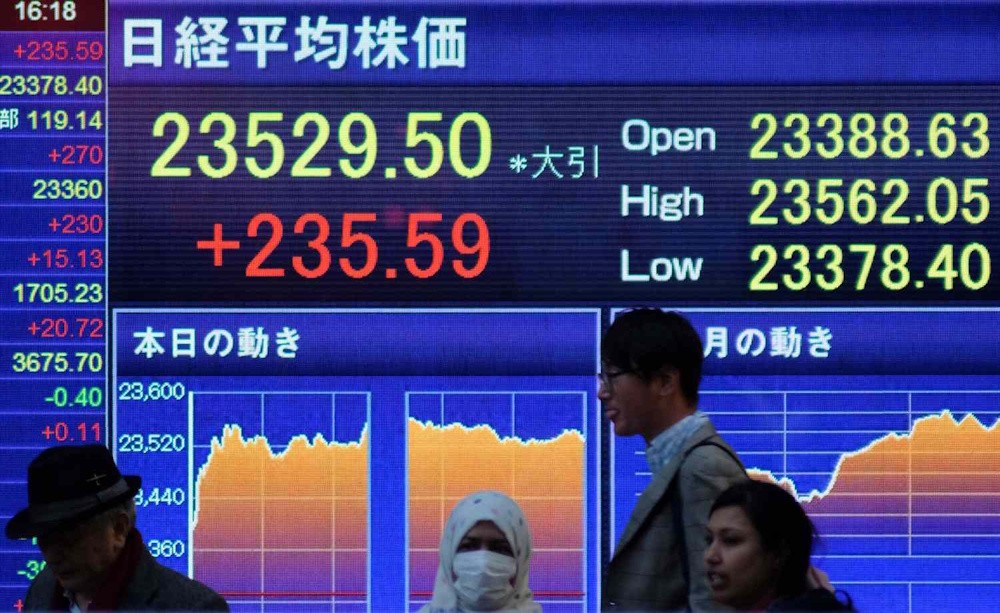
Japan’s Nikkei share average reversed course to conclude the day on a positive note on Monday, as chip-related stocks mitigated losses following South Korea’s announcement of extensive chip and AI mega-projects. The Nikkei closed 0.15% higher at 69,468.11, after experiencing a decline of as much as 1.97% earlier in the session. The broader Topix rose 0.47% to 3,982. South Korean President Lee Jae Myung stated that the world’s two largest memory chipmakers, Samsung Electronics and SK Hynix, would invest approximately $520 billion alongside suppliers to establish two new chip fabrication sites in the country.
“What pushed the Nikkei lower were chip-related shares, and what made the Nikkei reverse the loss were also chip-related shares,” said Kazuaki Shimada. Memory chipmaker Kioxia 285A reduced its initial losses, concluding the day with a decline of 4.5%. Chip-testing equipment manufacturer Advantest experienced a decline of 1.51%. Chip-making equipment manufacturer Tokyo Electron 8035 experienced an increase of 2.44%. Those shares declined in early trade following a 5.3% drop in the Philadelphia SE semiconductor index on Friday. The decline underscores recent volatility among AI-related chipmakers that have fuelled much of Wall Street’s gains in recent years.
On Monday, investors shifted their focus from AI-related stocks to those that have been underperforming, according to Shuutarou Yasuda, a market analyst at Tokai Tokyo Intelligence Laboratory. “There was a concern in the market that memory chip prices have risen too much,” he stated. Game maker Nintendo, whose profits have been squeezed by rising memory chip prices, jumped 5.25%, while Sony Group rose 3.13%.
The fragility of the U.S.-Iran interim peace deal has not emerged as a significant market-moving indicator in Japan, according to Yasuda. Energy-related shares, which generally exhibit a positive response to wartime tensions, experienced a decline on Monday. The mining sector experienced a decline of 1.83%, while oil refiners saw a decrease of 1.07%. Among the over 1,500 stocks listed on the prime market of the Tokyo Stock Exchange, 69% experienced an increase, 26% saw a decline, and 2% remained unchanged.
